AI and Large Language Models
What counts as AI, how a large language model works, and what that means for you.
Anonymous AI Survey#
Before starting, complete the class survey by clicking on this link. Answer honestly, your answers are not tied to your name. When you are finished, please head to the table with your name on it.
Disclaimer
The content in this lesson may be out of date. The last update was written in October 2026. AI tools, companies and research change month to month, so this information may become old. If you’re reading in the future, review this material with a grain of salt.
Slides: In Class

What exactly is AI?#
AI stands for Artificial Intelligence. With your group members, write down 5 examples of AI on your whiteboards.
Vote: AI or not AI?
For each one, decide: is this AI? Be ready to say why.
- Spell check in Google Docs
- The next-word suggestions on your phone keyboard
- Your TikTok or YouTube recommendations
- Google Maps picking a route
- A Snapchat filter that tracks your face
- An enemy in a video game that chases you
- Google Search Results
- Face ID unlocking your phone
- ChatGPT, Gemini or Claude
- A regular calculator
What counts as AI#
Computers operate largely through something called binary logic. Something is either on, or true, or a “1”; or it’s off, or false, or a “0”. We can structure binary in a way that allows computers to respond to inputs we provide it, but a computer always needs instructions for what it should do. We call these instructions “code”.
The term “AI” has always been slapped on to products when a company wants people to think it’s futuristic or does something new - and for a lot of products, that is true, but the term “AI” itself doesn’t mean anything in computer science.
- Program
- A single set of instructions that a computer uses to respond to an input.
- Algorithm
- A set of programs that are used in sequence to solve a problem or produce an output.
- Machine Learning, Generative AI
- An set of algorithms that allows a computer to create something new (text, images, audio, video) based on patterns it finds in previous data it has looked at
- Large language model (LLM)
- Generative AI that works with specifically with text. ChatGPT, Gemini and Claude are LLMs.
Revisiting the list from earlier, which description above best matches each of the uses of “AI”?
- Spell check in Google Docs
- The next-word suggestions on your phone keyboard
- Your TikTok or YouTube recommendations
- Google Maps picking a route
- A Snapchat filter that tracks your face
- An enemy in a video game that chases you
- Google Search Results
- Face ID unlocking your phone
- ChatGPT, Gemini or Claude
- A regular calculator
How an LLM works#
Predictive text#
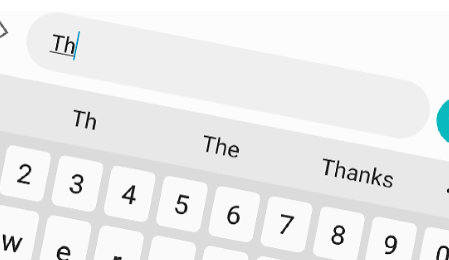
Your phone keyboard guesses the next word based on the words before it. An LLM does the same thing. It looks at everything written so far, picks the most likely next piece of text, adds it, and repeats until it has an answer.
You can predict text too
Everyone writes down one word to finish this sentence, without talking:
We’re out of eggs, give me a minute and I’ll run to the …
Math is so easy, two plus two equals …
January, February, March, April, May, …
The best thing to eat for breakfast is …
The exact population of Toronto is …
Colourless green ideas sleep big …
Tally the answers. The most common one is what a predictive text model would most likely pick. Is it the correct answer, or just the most common one? What happens when we introduce opinions? What about when it’s not clear what the answer is?
The difference with an LLM is scale. Your keyboard can learn from what you type, and gets good at predicting what comes next because human language is quite predictable. An LLM learns from a large part of the public internet, plus millions of books, articles and code.
An LLM does not look anything up. It produces the text that is most likely to come next. Most of the time, likely and true are the same thing. Sometimes they are not, but the important thing is that it will almost always try to give you an answer to something, even if it means making something up.
Watch: Large Language Models explained briefly (3Blue1Brown, 8 min)
Try: How LLMs Work on Brilliant. Class Code Sign Up Link
Training#
You hear often about new versions of ChatGPT or Gemini coming out all the time. These are called models. In order to create a model, you need to train it.
Watch: How Machines Learn (CGPGrey, 8 min)
-
Pre-training. The model is shown a piece of real text with the next word hidden. It guesses. Its numbers are nudged so the right answer becomes a little more likely. This is repeated trillions of times. Nobody writes the rules of grammar, facts or style into it. They show up because they help with the guessing.
-
Fine-tuning and reinforcement learning. People write example conversations and rate the model’s answers. Answers people prefer are rewarded, so the model does more of that. This is what turns “autocomplete for the internet” into an assistant that answers your questions.
Watch: MarI/O: Machine Learning for Video Games (SethBling, 6 min)
MarI/O learns by trial, score and repeat.
Talk about it
- Does MarI/O understand Mario? Could it beat a level it has never seen?
- An LLM gets a higher score when people like its answers. What might it learn to do that is not the same as being right?
Tokenization#
An LLM does not read letters or whole words. It reads tokens: chunks of text that are often a whole short word and often part of a longer one. On average a token is about three quarters of an English word. Every token is stored as a number, so to the model, your sentence is a list of numbers.
This is why LLMs have been bad at questions like “how many r’s are in strawberry?” The model never sees the individual letters.
Try: paste a sentence into the OpenAI Tokenizer and see where it gets cut up. Try a long word, a made-up word, and a sentence in another language.
Latent Space#
Each token is turned into a long list of numbers that works like a set of coordinates. Instead of a map with two axes (x and y), it has thousands of dimensions. This map is called latent space.
Training moves words with similar meanings close together on the map, and directions on the map end up meaning something. A famous example: start at king, subtract man, add woman, and you land near queen.
Try: the Embedding Projector. Search a word and see what is near it.
Watch: AI art, explained (Vox, 13 min)
AI in your life#
Group discussion
- Do you use AI? Which tools? (Don’t forget the ones built into other apps: Snapchat My AI, Meta AI in Instagram, Google’s AI Overviews, Grammarly.)
- What do you use it for?
- Have you ever used AI to help you with school work? (You won’t get in trouble for answering this one truthfully)
- What about AI excites you?
- What about AI worries you?
On your whiteboards, draw a T-chart: Good for people on one side, Bad for people on the other. Fill it in as your group reports back, then compare it with the list below. What did we miss? What is on our list that you disagree with?
| Good | Bad |
|---|---|
| A starting point for research, and it can explain the same idea five different ways | It makes things up and sounds just as confident |
| A tutor that is available all the time and never gets tired | Data centres use huge amounts of energy (to power) and water (to cool) |
| Lets people make things they could not before: code, games, music | It can generate fake images, video and voices of real people to spread misinformation |
| Accessibility, describing images for blind users, live captions, translation | If it does the thinking for you, you don’t get better at thinking |
| Takes care of repetitive work | It learns from writing and art nobody asked permission to use |
Some notable examples in the news lately:
- Hallucination. In 2024, a tribunal ruled that Air Canada had to honour a refund policy its own website chatbot invented.
- Energy. The International Energy Agency projects that electricity used by data centres will roughly double by 2030, with AI the biggest driver.
- Misinformation. In 2024, voters in New Hampshire received robocalls with an AI-generated copy of US President Biden’s voice telling them not to vote.
- Brain drain. A 2025 MIT Media Lab study found that students who wrote essays with ChatGPT showed less brain activity, and many could not quote a sentence from the essay they had just written.
The future#
Watch: Humans Need Not Apply (CGPGrey, 15 min)
Where do you stand?
- By the time I am 30, AI will have made life better for most people.
- AI will take more jobs than it creates.
- Art and music made by a person will be worth more because of AI.
- We should slow down AI development.
- The career I’m interested in after high school could be done by AI.
- AI could become dangerous to humans.
Is this good or bad?
- Jobs for entry-level office work (writing, customer service, basic coding) is starting to disappear
- Medical research speeds up. AlphaFold, an AI that predicts protein shapes, won its creators the 2024 Nobel Prize in Chemistry
- Most images, music and video online are machine-made
- Repetitive and dangerous work gets automated, freeing people up for other things
- Deepfakes of politicians saying harmful things are spread around the internet
- AI can help you learn about almost anything
- AI systems pursue goals their makers did not intend, and we can’t stop them
- Scientific discoveries that people could not have made alone
Talk about it
The skilled trades are some of the hardest jobs to automate. A robot that can fix the plumbing in any house it walks into is much harder to build than a chatbot.
Using AI well#
Class discussion
What are some healthy ways to use AI for school and in daily life? What should we avoid?
Slides: Learning to use an LLM as a student
| Helps you learn | Does the learning for you |
|---|---|
| “Quiz me on the parts of a 3D printer” | “Write my 3D printing journal” |
| “Explain why my micro:bit code isn’t working” | “Write the code for me” |
| “What is wrong with the argument in this paragraph?” | “Rewrite my paragraph” |
| “Explain this idea in a different way” | “Give me the answers to this worksheet” |
Some rules worth having:
- Try it yourself first. Use AI to check your thinking or get unstuck, not to skip it.
- Check anything that matters against another source.
- Do not type in personal information about yourself or anyone else.
- Say when you used it, and what for. Practice honesty.
Why bother learning it yourself?#
Why bother going to the gym? Learning works the same way. The struggle of figuring something out is the part that builds the skill. Just like being fit and healthy, being educated and intelligent leads to a feeling of fulfilment in your life.
Journal prompt
Complete the AI and Large Language Models journal entry.