Engineering Design Process
How to create things in this class using an iterative process
The interactive version of this diagram walks through the same loop one stage at a time.
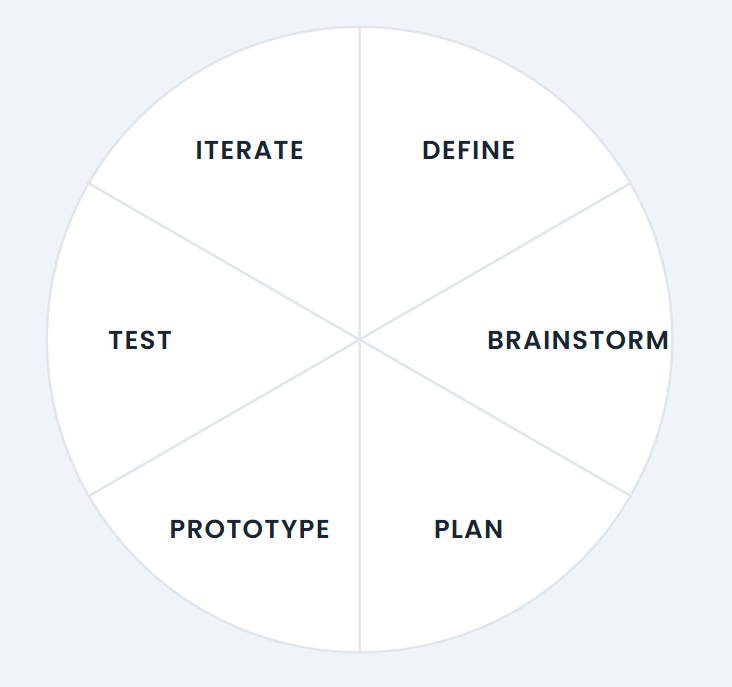
The Process#
Define#
What problem are you solving? Who is it for? Identify constraints like time or budget, and picture a successful outcome.
Brainstorm#
Imagine many possible solutions! Research existing ideas, sketch freely, and don’t be afraid to think outside the box.
Plan#
Pause and create a detailed blueprint. This includes drawings, a list of materials, and step-by-step instructions for your best idea.
Prototype#
Build a basic, working model of your solution. It doesn’t need to be perfect! The goal is to create something you can test quickly.
Test#
Put your prototype to the test! Does it solve the problem? How does it perform under different conditions? Observe what works and what fails.
Iterate#
What did you learn from testing? What new questions do you have? Use this information to improve your design and begin the cycle again.
Cycling through#
The big idea of the engineering design process is that it is not linear. It has no start or finish point. You could, in theory, begin a the process at any step, and end at any other step. The advantage of the process is that it is cyclical, meaning it can (and should) be repeated multiple times. Once you’re finished your first “cycle”, you continue through with a new view on each step.
Define Again#
Based on your tests, redefine the problem. What new challenges appeared? Have your goals for success changed?
Brainstorm Again#
With new insights, what are some different approaches? Can you improve your original concept or combine ideas?
Plan Again#
How will you modify your design? Update your drawings, list of materials, and plan for building the next version.
Prototype Again#
Build the next version of your prototype. Focus on implementing the changes and improving the weak spots from your last test.
Test Again#
Rigorously test your new prototype. Compare its performance to previous versions. Does it solve the newly defined problems?
Iterate Again#
Reflect on this latest cycle. What are the key takeaways? Decide on the most important focus for the next round of improvements.
The EDP is Not an Excuse to Be Lazy
Iteration requires sufficient data collection to be useful. If you are rushing through a build of something as fast as possible, you’re going to cut too many corners and end up with a result that is wasteful for how little data it provides you with. Resources in this classroom (and in the outside world) cost money and are not something that should be carelessly exhausted for the sake of it. If you are wasteful or not being mindful about your material use in the class, you will be prevented from iterating on your designs.